
Across the U.S., restaurants increasingly compete on concept as much as cuisine, using immersive design, themed service and unusual room layouts to stand out in a crowded market. In New Orleans, that approach is not a trend so much as an extension of the city’s long-running mix of hospitality, performance and folklore. Five local restaurants and bars in particular have built experiences that are difficult to replicate anywhere else, from Gothic dining rooms to moving furniture and a famously haunted upstairs lounge.
A vampire cafe, a ghost table and a rotating bar define the list
The New Orleans Vampire Café in the French Quarter is one of the clearest examples of a restaurant built around a fully developed premise. The café says it welcomes “vampires and mortals alike,” and its public materials emphasize blood-themed cocktails, dark décor and a menu designed to keep the concept consistent beyond October, according to the restaurant’s official site. That makes it more than a costume-season novelty; it is a year-round business built on one of the city’s best-known supernatural themes.
Muriel’s Jackson Square takes a different approach by tying its identity to the building’s own history. The restaurant says it opened on March 10, 2001, after restoring the mid-1800s property, and New Orleans tourism materials identify the site with the story of Pierre Antoine Lepardi Jourdan, who died in 1814 after reportedly losing the property in a poker game. Muriel’s also maintains a “Ghost Table” and promotes its upstairs Séance Lounge as part of the guest experience, according to the restaurant and local tourism sources.
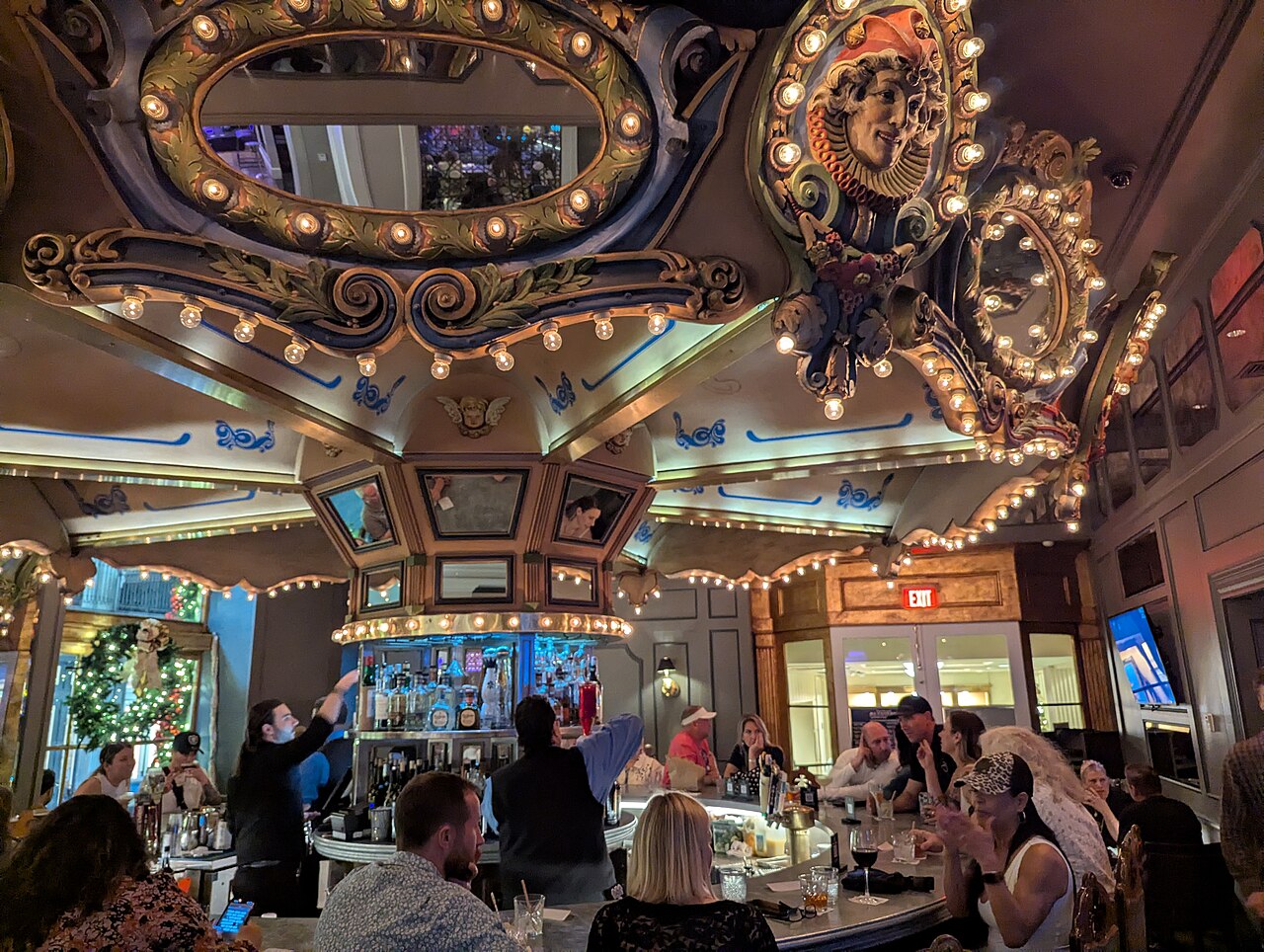
At Hotel Monteleone, the Carousel Bar & Lounge is unusual for mechanical reasons as much as visual ones. The hotel says the 25-seat bar was installed in 1949 and completes one full rotation about every 15 minutes, while the bartender remains at the stationary center. Hotel Monteleone also describes it as the only revolving bar in New Orleans, giving it a specific scale and distinction that has helped keep it a draw for visitors and locals alike.
The local impact is concentrated in a few New Orleans neighborhoods
What is confirmed is that all five places highlighted in the reference reporting are in New Orleans, and several are clustered in well-trafficked dining and tourism corridors. The New Orleans Vampire Café and Muriel’s Jackson Square are both in or near the French Quarter and Jackson Square area, while the Carousel Bar operates inside Hotel Monteleone on Royal Street. Jacques-Imo’s Café is on Oak Street, and Turkey and the Wolf built its following in the city’s sandwich scene with a neighborhood format rather than a conventional fine-dining setting.
Jacques-Imo’s has been operating since 1996, according to the restaurant, and it remains known for details that blur the line between dining room and performance space. The restaurant lists its address as 8324 Oak Street, and its published menu still includes its shrimp and alligator sausage cheesecake, one of the dishes most associated with the restaurant’s offbeat identity. Reference reporting also notes the demand for the pickup-truck table attached to the front of the building, a detail that reinforces how much of the appeal is tied to the physical setup.
Turkey and the Wolf shows that “unusual” in New Orleans does not always mean haunted or theatrical. The restaurant’s own media page notes that Bon Appétit named it America’s Best New Restaurant in 2017, recognition tied to a sandwich shop format that elevated fried bologna, collard greens and other familiar ingredients into nationally watched menu items. What is not publicly standardized is any single official count of how many guests each of these venues serves daily, and no comprehensive city dataset ranks them by uniqueness; their reputations are established through their concepts, locations and documented media attention.
Their staying power reflects how New Orleans sells experience as well as food
The broader context is that New Orleans has long supported restaurants that function as cultural destinations in addition to places to eat. That helps explain why venues rooted in folklore, architecture or nostalgia can remain relevant alongside more conventional operations. In these five cases, the concept is not separate from the product; it is part of the service model, whether that means a blood-bag cocktail, an upstairs séance room, a rotating bar stool or a sandwich menu that turns lowbrow Americana into a chef-driven attraction.
Turkey and the Wolf illustrates the national side of that equation. Bon Appétit’s 2017 recognition gave the restaurant credibility well beyond Louisiana, and the restaurant’s own media materials continue to foreground that award. In other words, a highly specific local idea became exportable as a brand story without needing to abandon the neighborhood identity that made it distinctive in the first place.
For customers, the practical takeaway is straightforward: these are not interchangeable stops, even in a city known for theatrical dining. Some offer atmosphere as the main differentiator, while others use menu construction, building lore or mechanical design to create the experience. What diners can expect, based on restaurant and hotel descriptions, is that each venue continues to present its signature concept as a core part of service rather than a limited-time gimmick, which helps explain why all five still stand out in New Orleans’ crowded food landscape.
I’m very pleased to uncover this page. I want to to thank you for your time for this particularly wonderful read!!
I definitely savored every little bit of it and I have you bookmarked to look at
new stuff on your blog.
Feel free to visit my web site … 소액결제현금화