
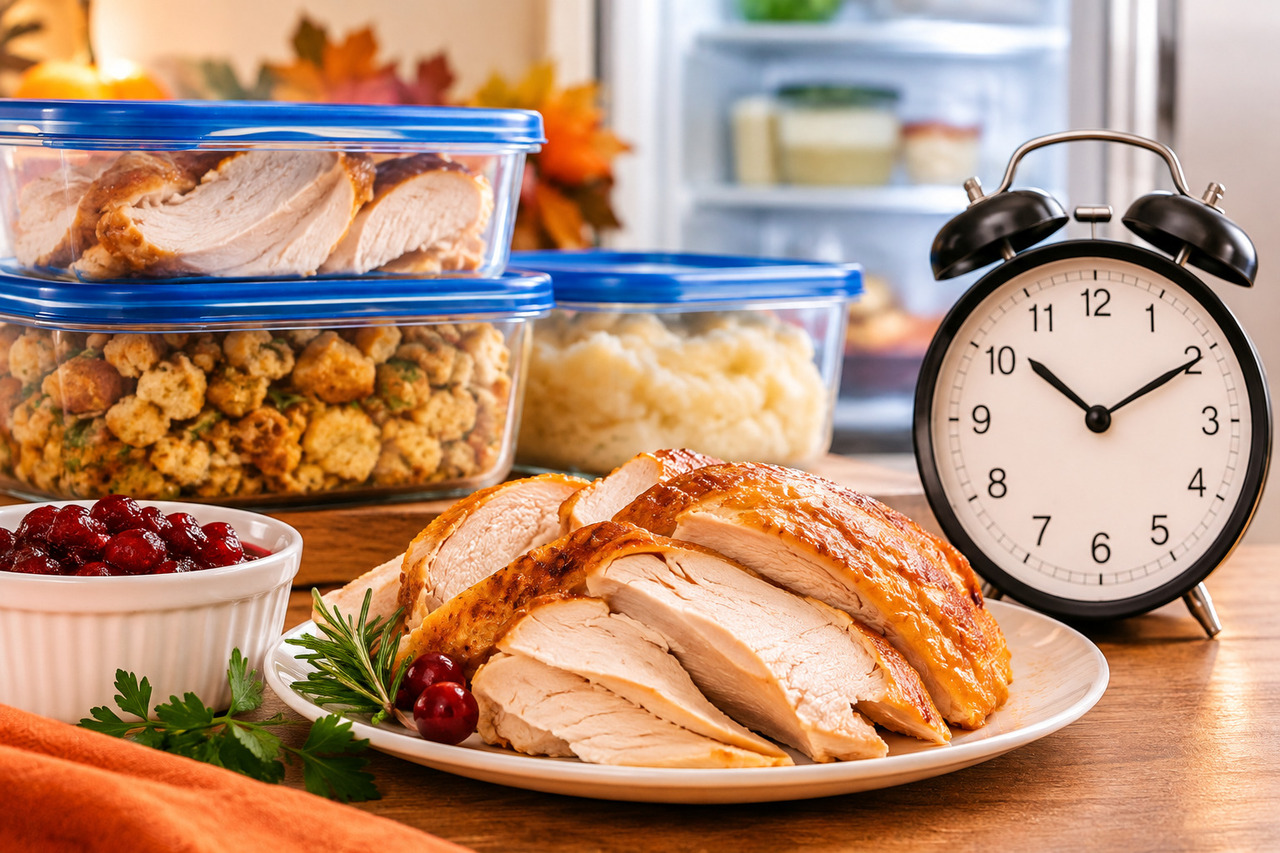
The holiday meal may be over, but the food-safety risk is not. Leftover turkey has a surprisingly short grace period, and experts say many Americans push it too far.
What matters most is not just how the turkey was cooked, but how quickly it was cooled, packed, and refrigerated. That is where the real countdown begins.
The safe window is shorter than most people assume
For many households, Thanksgiving leftovers are treated like a weeklong reward. But USDA guidance is much tighter: refrigerated leftovers should generally be used within 3 to 4 days, and that includes cooked turkey, casseroles, soups, gravy, and stuffing. CDC holiday turkey guidance echoes that same timeline and says leftovers should be refrigerated within 2 hours of cooking.
That 2-hour rule is not a technicality. Bacteria grow fastest in the temperature “danger zone” between 40°F and 140°F, and CDC warns that Clostridium perfringens is a frequent culprit in holiday food poisoning, especially in November and December. Its symptoms, including abdominal cramps and vomiting, can begin within 6 to 24 hours after eating contaminated food.
The countdown also starts before the food hits the plate the next day. If the turkey sat out through a long meal, lingered on a buffet, or stayed in the roasting pan for hours while guests talked, some of that safe storage time may already be gone. Experts consistently advise dividing large portions into smaller, shallow containers so they cool faster in the refrigerator.
Temperature matters as much as time. FDA says refrigerators should be kept at 40°F or below, with freezers at 0°F. A fridge that runs warm can quietly shorten the real safety margin even if the leftovers look and smell fine.
Why smell and appearance are poor safety tests
One reason leftover turkey gets risky is that people often trust their senses more than the calendar. Foodborne bacteria do not always leave obvious clues, so turkey can look normal, smell acceptable, and still be unsafe. Federal food-safety agencies repeatedly stress that appearance is not a reliable indicator.
That matters because holiday leftovers are often handled in ways that raise the risk. A whole bird cools slowly, dense stuffing can trap heat, and gravy or casseroles may spend too long at room temperature before anyone thinks about storage. FDA food-cooling guidance for safety foods emphasizes moving cooked food through the cooling range promptly, not leaving large hot masses to slowly come down in temperature.
There is also a common misconception that reheating fixes everything. It helps, but it does not erase every food-safety mistake made during storage. If leftovers were left out too long, held above 40°F for too many hours, or cycled repeatedly from fridge to counter to microwave, experts say the safer choice is to discard them.
Power outages can complicate the picture further. FDA says refrigerated perishable foods, including leftovers, should be thrown out if they have been above 40°F for 4 hours or more. That is especially important after storms or overloaded holiday refrigerators that do not cool efficiently.
How to stretch your leftovers safely without pushing your luck
The smartest way to keep turkey longer is not to keep it in the refrigerator longer. Freeze it. USDA and FDA both recommend freezing leftovers for extended storage, and USDA advises freezing them within that 3- to 4-day refrigerated window if you will not eat them in time.
Portioning helps here, too. Slice turkey off the carcass, package meal-size portions, and label containers with the date. Smaller packs thaw faster, reheat more evenly, and reduce the temptation to repeatedly rewarm one giant container just to pick at it for another day.
If you are dealing with a very full refrigerator, make room before the holiday meal if possible. Cold air needs to circulate to keep foods safe, and FDA recommends using a refrigerator thermometer rather than guessing. That is a small step, but it can prevent the quiet drift above 40°F that turns leftovers into a gamble.
The bottom line is simple and stricter than many families realize: refrigerate turkey within 2 hours, keep the fridge at 40°F or below, eat refrigerated leftovers within 3 to 4 days, and freeze what you cannot finish. When the timeline gets fuzzy, experts are clear on the best rule of all: when in doubt, throw it out.