
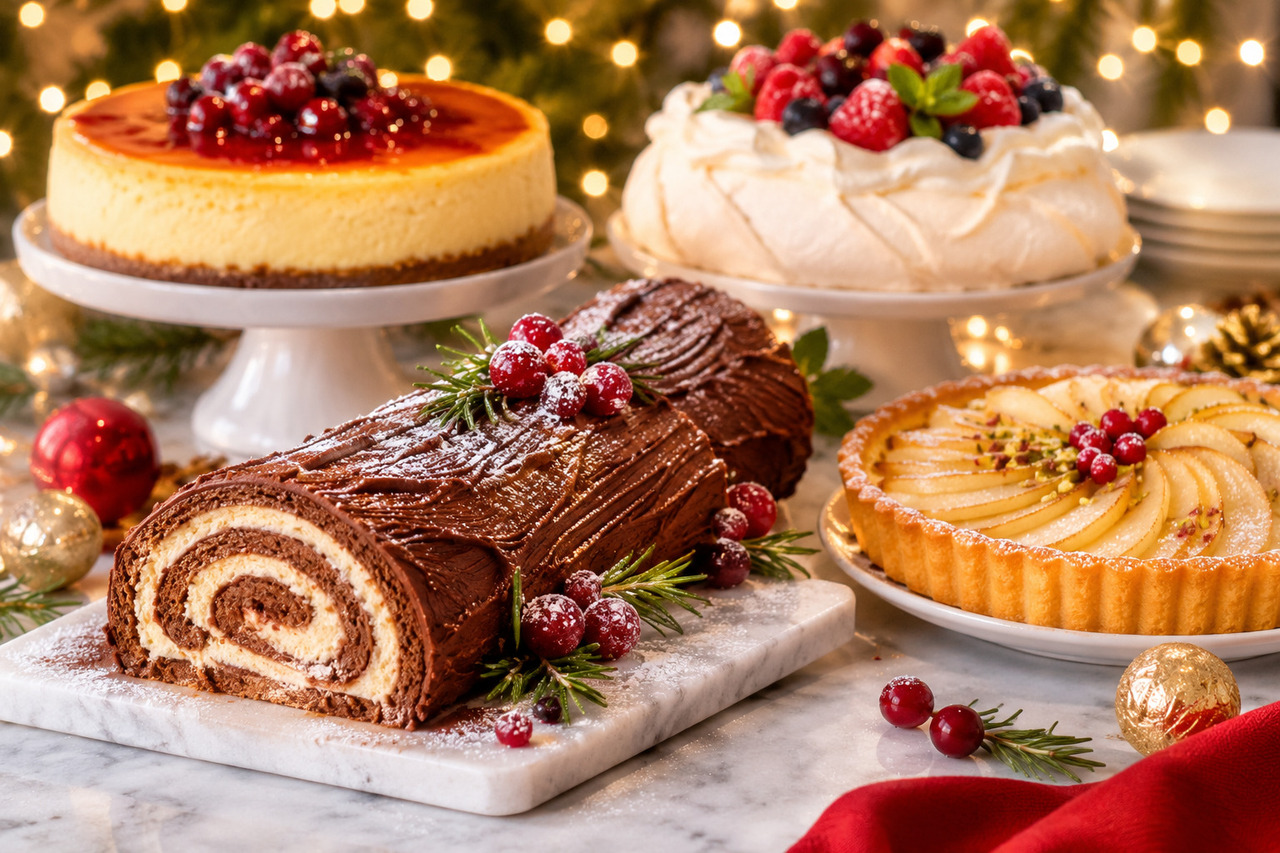
Holiday desserts do not have to announce thrift to be affordable. In fact, the smartest sweets on the table are usually the ones that look rich, tall, glossy, and giftable while being built from low-cost staples and a few clever shortcuts.
This year, that strategy matters even more. Grocery costs remain elevated, but some of the ingredients that create the biggest visual payoff are still remarkably budget-friendly, making dramatic desserts one of the easiest ways to impress a crowd without overspending.
Cheap structure, expensive effect
The secret to a “how much did that cost?” dessert is usually structure, not luxury ingredients. Flour remains one of the cheapest foundations in the kitchen: the Bureau of Labor Statistics recently listed all-purpose flour at $0.536 per lb., while white sugar came in at $1.001 per lb. and large eggs averaged $2.320 per dozen in October 2026. Those are the bones of cakes, roulades, pavlovas, tart shells, and choux, all of which look far grander than their ingredient lists suggest.
That is why sponge-based desserts are such a holiday power move. A jelly-roll cake dusted with cocoa, filled with whipped cream, and styled as a Yule log reads as classic patisserie, yet it is mostly eggs, sugar, flour, and air. Meringue works the same way: pavlova and layered dacquoise look celebratory because of height and texture, not because they require costly raw materials.
Even frozen puff pastry earns its place in this category. Food media outlets continue to feature pear tarts, chocolate-filled pastry bundles, and laminated holiday bakes because they deliver instant elegance with minimal labor. The visual language of layers, gloss, and browned edges signals “special occasion,” even when the dessert itself is fundamentally a wrapper around fruit, custard, or sweetened cream.
Store-bought desserts with bakery-level swagger
Warehouse clubs have become one of the most overlooked sources of genuinely affordable holiday centerpieces. Sam’s Club currently lists a Member’s Mark tiramisu cake at $14.98, a 9″ New York style cheesecake at $14.84, and a 9″ pumpkin cheesecake with 14 slices at $16.84. Those prices land well below what many local bakeries charge for similarly sized holiday desserts, especially once decoration and seasonal demand are factored in.
The same pattern shows up in party-ready assortments. A 60-count holiday cookie tray is priced at $19.93, while an 8-count assorted cheesecake set runs $19.87. Cost per serving drops quickly, but presentation does the heavy lifting: arrange slices on a cake stand, add sugared cranberries or citrus peel, and the spread instantly looks custom-curated rather than club-bought.
Imported-style classics are another bargain category. Sam’s Club lists a Bauducco all-butter panettone gift box at $5.98, a reminder that tall, boxed, ribbon-friendly sweets can look premium while staying squarely in impulse-buy territory. Panettone, tiramisu, and cheesecake all benefit from a built-in aura of occasion, which is exactly why they outperform their price tags at the holiday table.
Where to spend, where to save
If you want maximum drama for minimum money, spend on the ingredient guests notice first and save on the parts they do not. Chocolate is the category to watch most carefully: the Bureau of Labor Statistics reported that confectionery ingredient costs are heavily tied to cocoa, sugar, and corn syrup, and USDA says sugar and sweets prices were 5.5 percent higher in September 2026 than a year earlier, with a 6.5 percent increase forecast for 2026 overall. In plain terms, chocolate-heavy desserts can get expensive faster than flour-based or fruit-forward ones.
That makes selective luxury the winning formula. Use a modest amount of good chocolate as a drizzle, shard, or ganache accent rather than building an entire dessert around multiple premium bars. Let whipped cream, mascarpone-style fillings, toasted sugar, jam, citrus zest, roasted nuts, and glossy fruit compotes create the impression of abundance.
The broader holiday food landscape reinforces the value of this approach. The American Farm Bureau Federation’s 2026 Thanksgiving survey found the average feast for 10 rose to $58.63, the first increase since 2022, while USDA expects food-at-home prices to climb 2.3 percent this year. In that environment, desserts that look custom, festive, and lavish while relying on inexpensive structure are not just clever; they are the most stylish kind of practical.