
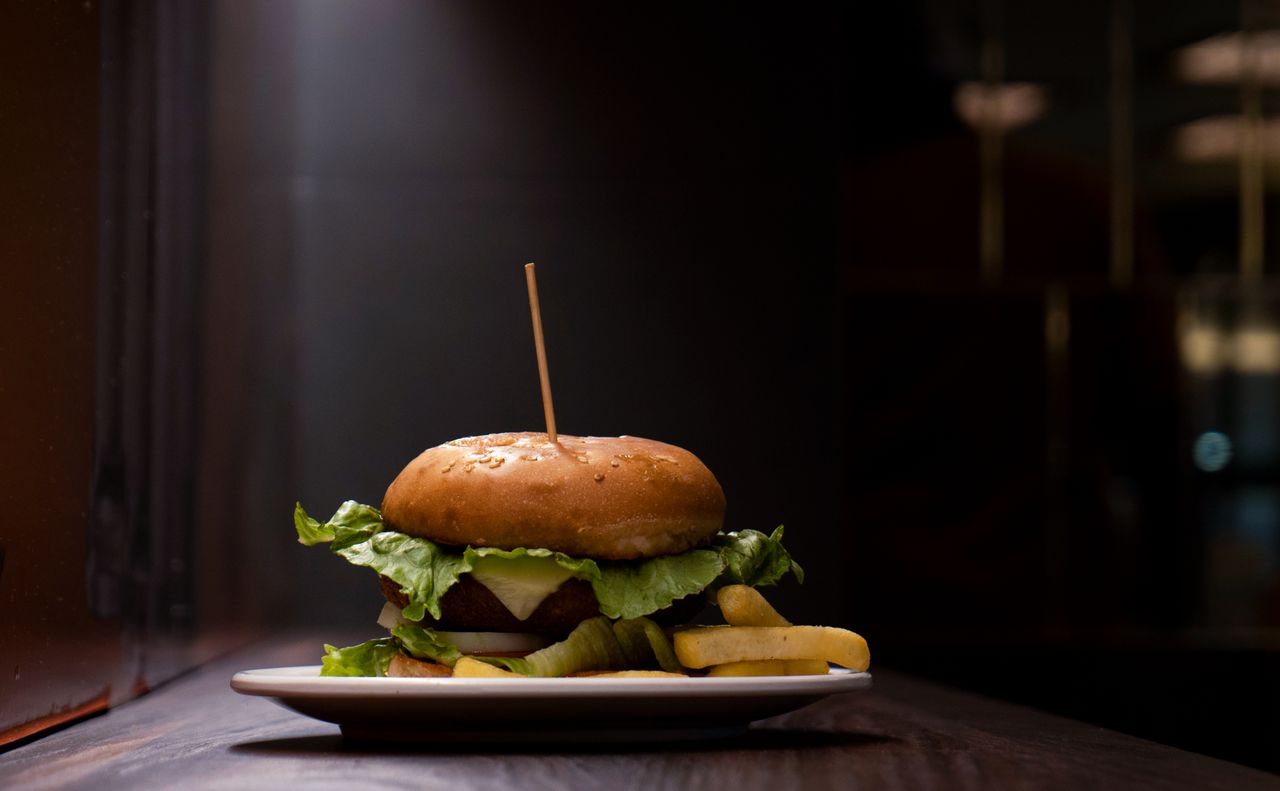
Artificial intelligence is moving deeper into the food business as companies and universities test whether algorithms can speed up product development and help balance taste, nutrition, and sustainability. At Stanford University, researchers used that approach on one of the country’s most familiar foods: the burger. Their results, published in late June, turned a Bay Area restaurant tasting into an unusually concrete test of whether an AI system can make food people actually want to eat.
Stanford’s BurgerAI moved from recipe data to a real-world taste test
Stanford researchers announced on June 26 that they had developed BurgerAI, a generative system designed to create burger recipes optimized for taste, health, and environmental performance, according to Stanford Report and the peer-reviewed paper published in npj Science of Food. The team reported training the system on 2,216 recipes using 146 ingredients, then using the model to search a recipe space it estimated at more than 10 to the 44th possible combinations. That scale matters because the project was presented not as a novelty image generator, but as a tool for structured food design.
The researchers then took the project beyond simulation. Stanford said five professionally prepared, AI-designed burgers were served in a blinded tasting at a San Francisco restaurant to more than 100 diners, while the paper lists 101 participants in the sensory evaluation. In the published results, the system’s “delicious” burgers scored the same or better than a Big Mac reference in overall liking, flavor, and texture, according to the paper and Stanford’s summary of the findings.
The study also said BurgerAI could rediscover a classic burger pattern without being directly told to copy it. In the paper, the model was described as able to reproduce a recipe resembling the Big Mac without explicit supervision, while also generating newer combinations that rated highly with tasters. Stanford researchers including Ellen Kuhl, Vahidullah Tac, and Christopher Gardner were named on the work.
The Bay Area connection is clear, but the local rollout is not
For local readers, the most direct Bay Area tie is the live tasting itself. Stanford said the blinded test was conducted at a San Francisco restaurant, making the region the first public proving ground for the burger experiment rather than just the home base of the university. That gives the study a concrete local footprint, even though BurgerAI is still a research project rather than a consumer product or restaurant launch.
What is confirmed is that Bay Area diners were part of the evaluation process and that Stanford framed the work as a practical food-design tool with possible commercial applications. What is not yet known is whether any restaurant, food manufacturer, or Stanford-affiliated dining program plans to put BurgerAI-designed burgers on a permanent menu. Stanford has not announced a retail rollout, licensing agreement, or a list of specific California restaurants that may test the recipes next.
The local significance also comes from geography and industry overlap. Stanford sits at the intersection of Silicon Valley computing research and California food innovation, where universities, startups, and large consumer brands regularly collaborate on new product development. In that context, the burger project reads less like a one-off stunt and more like an early-stage demonstration of how AI could be used in menu development and alternative-protein formulation.
Researchers say the bigger goal is faster food design with measurable tradeoffs
The Stanford team said the project was built to address a long-standing problem in food development: improving one trait, such as taste, can make it harder to improve another, such as nutrition or environmental impact. In Stanford’s account and the npj Science of Food paper, the researchers described BurgerAI as a way to navigate those tradeoffs systematically instead of relying only on slow cycles of kitchen testing, consumer panels, and reformulation. The burger was used as a model food because it is familiar, variable, and easy to compare across versions.
That broader context helps explain why the findings drew attention. The paper reported that one mushroom-based burger achieved an environmental impact score more than an order of magnitude lower than the Big Mac benchmark, while a bean-based burger reached nearly twice the nutritional score. Those results suggest the model was not simply ranking indulgent recipes higher, but searching for combinations that could satisfy multiple goals at once.
For customers, the immediate takeaway is limited but tangible. No Stanford-designed burger has been announced for general sale, and the university has not said when or where consumers might buy one. What the study does show, based on a San Francisco tasting with 101 participants and a peer-reviewed publication, is that AI-assisted food design is moving from theory into test kitchens, with taste still treated as the deciding factor.
Нужно оформить сертификат ТР ТС на продукцию, но столкнулся с тем, что разные компании называют совершенно разные сроки, стоимость и перечень необходимых документов, а некоторые обещают выдать сертификат без испытаний и образцов. Не хочется переплачивать посредникам, но ещё опаснее получить документ, который потом окажется недействительным или вызовет проблемы при проверке и продаже товара. Как вы выбирали центр сертификации и на что обязательно нужно обратить внимание перед заключением договора? Подскажите как проходит [url=https://telegra.ph/Sertifikaciya-odezhdy-07-29] сертификация одежды[/url]
The variety of slots here is insane. I spent the whole night playing and had a great time. Definitely visit okjilicasino if you love slots.
Honestly, the loading speed here is impressive. I had a few issues with other platforms, but gv999apk works like a charm on my phone. Highly recommended for casual players.