
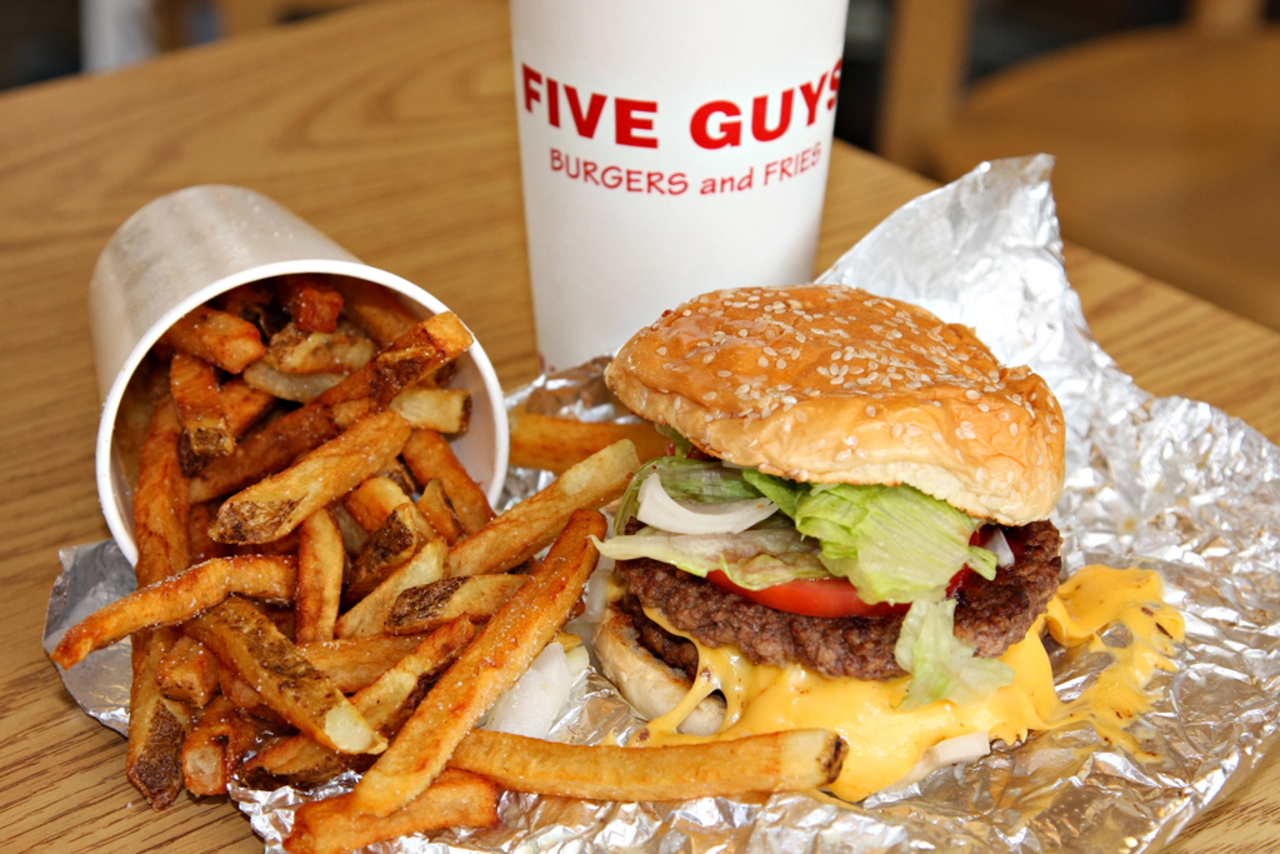
Restaurant chains across the U.S. are continuing to adjust store counts in 2026 as higher operating costs and softer consumer spending pressure the fast-casual segment. Five Guys is among the burger brands trimming locations, with reports showing at least 10 closures outside California this year and confirmed shutdowns in six states.
Five Guys is closing restaurants in multiple states in 2026
Five Guys has reportedly closed at least 10 locations outside California in 2026, according to industry reporting cited by NewsBreak. The chain has not publicly issued a comprehensive closure announcement, but reports indicate the affected restaurants shut down between January and May 2026. One of the most closely watched closures was in Naperville, Illinois, at 2856 S. Route 59, which was reported closed on May 14, 2026.
The same reporting identified other closures in Tampa, Florida; Dubuque, Iowa; Lake Charles, Louisiana; Atlanta, Georgia; and Lincoln, Nebraska. Exact closure dates for several of those restaurants were not publicly released. Because Five Guys has not published a full list, the currently available count should be treated as a minimum rather than a complete nationwide total.
The broader footprint remains large even with the reductions. NewsBreak reported that Five Guys still operates more than 1,500 U.S. restaurants and continues to open stores in selected markets. That makes the 2026 closures notable as a targeted contraction rather than a brand-wide retreat from the U.S. market.
Illinois and Florida are among the states with confirmed losses
Based on the publicly identified closures in the available reporting, Illinois, Florida, Iowa, Louisiana, Georgia and Nebraska each have at least one confirmed Five Guys closure in 2026. Illinois drew particular attention because the Naperville restaurant was specifically identified by address, giving the clearest public example of a location that has already gone dark. Florida also had a confirmed closure in Tampa during the first half of the year.
What is not yet clear is which states are losing the most locations by final count in 2026. The source material confirms at least one closure in each of the six states named above, but it does not provide a full state-by-state breakdown of all 10 or more closures reported outside California. The company has not released a comprehensive list of affected locations, and no public filing in the provided material assigns higher verified totals to any one of those states.
California is referenced in the source material as a state that had already seen several closures, but the topic here is the multi-state picture outside California. For readers in the six named states, the confirmed impact is city-specific: Naperville, Tampa, Dubuque, Lake Charles, Atlanta and Lincoln. No additional city lists for those states were confirmed in the source material.
Rising costs and slower spending are driving the pullback
The closures come as fast-casual restaurant operators face a difficult 2026 cost environment. Analysts cited by NewsBreak pointed to inflation, higher food costs, wage increases and reduced discretionary spending as key pressures on chains that depend on premium-priced menu items. Five Guys, which has built its business around higher-priced burgers and fries than many traditional fast-food rivals, has also faced public criticism over affordability.
The available reporting suggests the company is not simply shrinking everywhere. NewsBreak said Five Guys is still opening restaurants in some markets, including Lakewood Ranch, Florida, and Jackson, Mississippi. That pattern indicates a portfolio shift toward locations and regions the company believes are performing better, rather than a uniform nationwide downsizing.
For customers, the practical takeaway is that local availability may change even as the brand remains active in other nearby markets. Five Guys has not announced a nationwide closure wave or released a full 2026 closure roster, but the confirmed shutdowns show that some underperforming restaurants are being removed from the system while expansion continues elsewhere.
Hi there superb blog! Does running a blog like this require a great deal of work?
I’ve no knowledge of computer programming however I was hoping
to start my own blog in the near future. Anyhow, should you have any recommendations or tips for new blog owners please share.
I know this is off subject nevertheless I just wanted to ask.
Many thanks!