
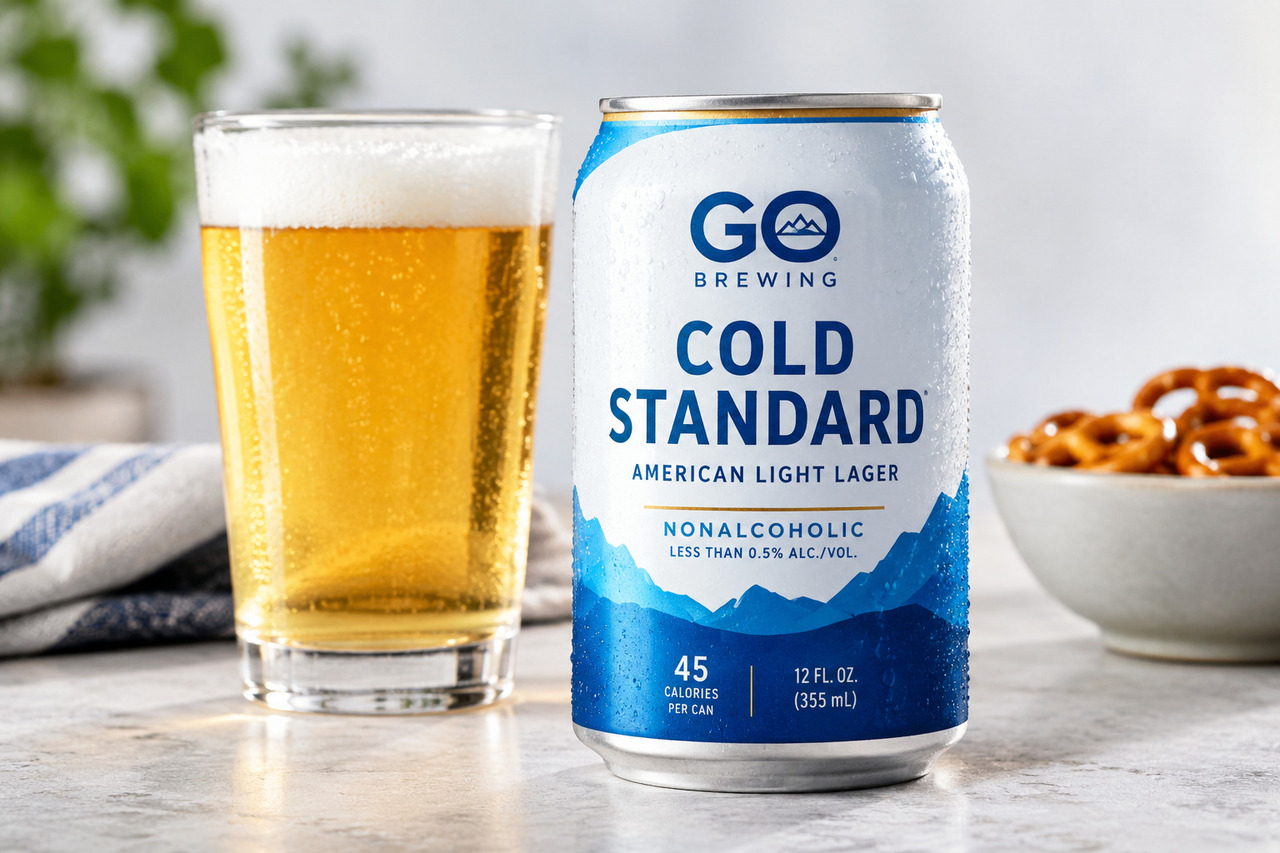
Go Brewing’s new Cold Standard is raising eyebrows for a very specific reason: the can leans hard into a familiar light lager look, while making its nonalcoholic identity less front-and-center. For shoppers, that tiny packaging choice matters because nonalcoholic beer labels still follow detailed federal rules, and because more brands are trying to make NA beer feel like an everyday grab rather than a separate category.
Why Cold Standard’s can is getting attention
Cold Standard is Go Brewing’s new American light lager, and the company describes it as a 45-calorie brew sold in 12-ounce cans. On Go Brewing’s product page, the beer is presented as “American Lite Brew” and “a beer for the rest of us,” with the nonalcoholic wording present but not doing most of the visual heavy lifting. According to Go Brewing’s media page, the brand entered the NA light lager space in early October 2026.
That quieter treatment of the nonalcoholic designation is the part drawing attention. The point is not that the can hides what it is, but that the package appears designed to read more like a standard domestic light beer first, then an NA product second. That is a notable shift in a segment where many cans have traditionally made “non-alcoholic” the biggest thing on the front.
The rest of the product details support that mainstream-beer pitch. Go Brewing says Cold Standard is brewed in Naperville, Illinois, made to stay under 0.5% ABV, and built around a crisp, clean, easy-drinking light lager profile. The company also says the beer is shipping online now and is “coming to stores in January,” with its product page stating a retail launch at partners across the U.S. in January. Food & Wine, according to the source notes provided, reported a Wegmans launch planned for January 2027.
What federal labeling rules say
This packaging conversation matters because U.S. labeling rules do not treat every low or zero alcohol term the same way. The Alcohol and Tobacco Tax and Trade Bureau says a malt beverage may use the term “non-alcoholic” only if the statement “contains less than 0.5 percent alcohol by volume” appears immediately adjacent to it, in readily legible print, and on a completely contrasting background.
The TTB also draws a separate line for “alcohol free.” That term may be used only on malt beverages containing no alcohol at all. TTB guidance further says malt beverages with less than 0.5% alcohol by volume must use a class designation such as “malt beverage,” “cereal beverage,” or “near beer,” not standard beer style terms on their own.
That helps explain why tiny wording choices on a can can attract scrutiny. A brand can absolutely aim for a cleaner, more conventional beer look, but it still has to fit within the federal labeling framework for sub-0.5% malt beverages. In other words, less prominent is not the same as absent. The design may feel more subtle to shoppers, yet the required information still needs to appear in the form regulators expect.
What shoppers should notice on the shelf
For home shoppers, the practical takeaway is simple: if you are buying nonalcoholic beer, read past the largest design elements on the front of the can. The most useful clues are often the ABV statement, the class designation, and any nearby wording that clarifies whether the drink is nonalcoholic or alcohol-free. Those details can affect expectations for taste, ritual, and who in the household may want to drink it.
Cold Standard is a strong example because the beer is being sold as a familiar light lager experience. Go Brewing says it is formulated from the start to stay under 0.5% ABV, rather than having alcohol removed later, and lists the beer at 45 calories per 12-ounce can. The company is currently selling it online, with a six-pack listed at $14.99 on the product page when last crawled, though that launch pricing is clearly promotional and tied to the brand’s own site.
Other brands show how varied the category can be. Heineken’s U.S. site currently describes Heineken 0.0 as 0.0% alcohol, and its site footer includes “Share with 21+ only,” a reminder that age-related messaging around NA beer can still look a lot like regular beer marketing. That does not mean every package says the same thing, but it does show why careful label reading matters before a can lands in your cart.