
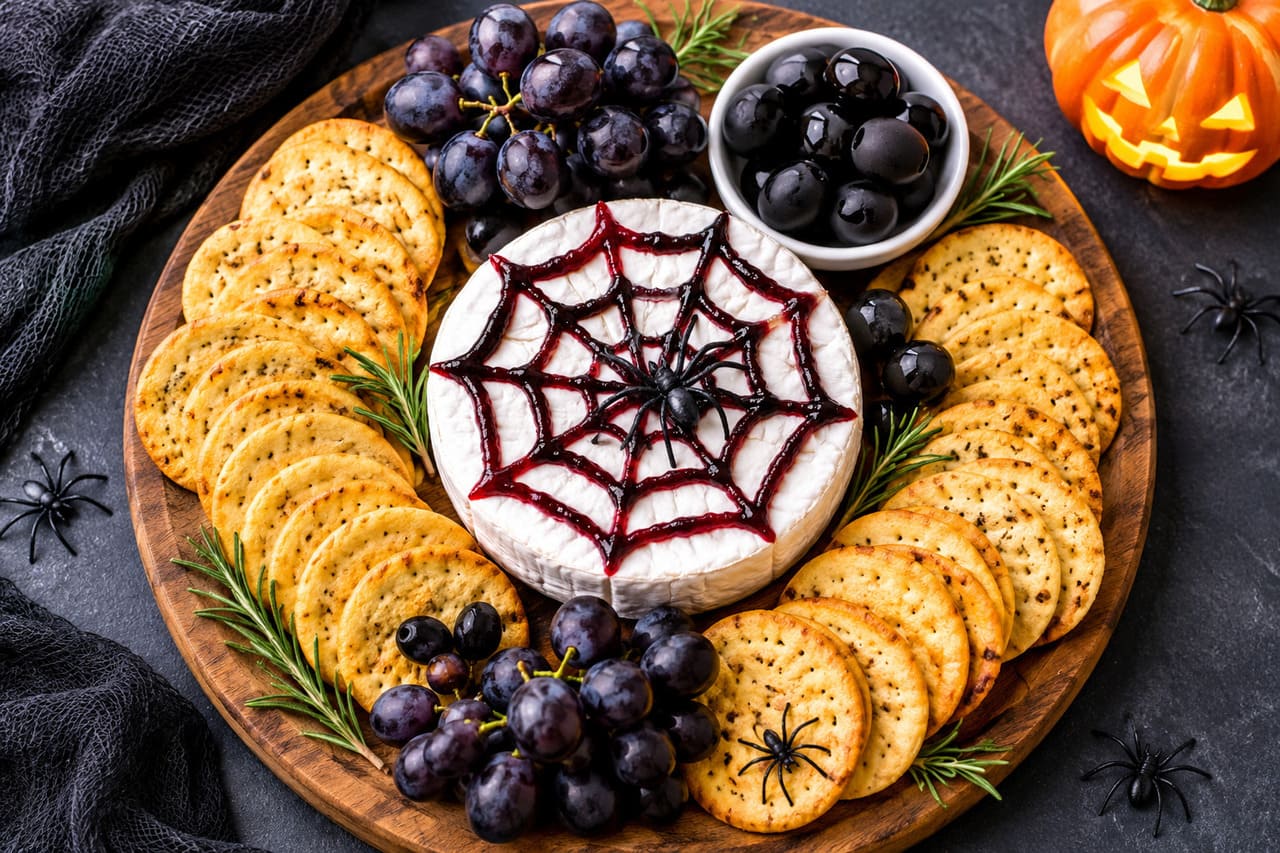
Halloween entertaining rewards drama more than difficulty. The smartest party hosts know that a few well-chosen ingredients can create the illusion of a much bigger effort.
Start with one showpiece cheese
If you want a Halloween spread to look styled instead of assembled, put the visual weight on the cheese. Food Network’s Halloween charcuterie coverage leans into exactly that idea, using bold, dark, sculptural cheeses and simple decorative finishes to make a board feel occasion-specific without adding a dozen components. The principle is useful even when you scale it down to three ingredients: one standout cheese creates the entire mood.
Brie is especially effective because it acts like a blank canvas. A small wheel topped with a spiderweb of jam, balsamic glaze, or another dark contrast instantly reads as themed, and it does so without requiring carving skills or baking. Cheddar also works if you want a stronger orange signal that nods to pumpkins and autumn leaves. A soft goat cheese log can be rolled or plated as a centerpiece when you want something a little more modern.
The key is contrast, not complexity. Halloween food styling succeeds when textures and colors do the heavy lifting: pale cheese, dark garnish, rough cracker edges, and a board with a little negative space. That is why a single dramatic cheese often looks more expensive and more deliberate than a crowded platter filled with random snacks.
Add a crisp base that frames everything
Your second ingredient should be the frame, not the star. Crackers are the obvious answer because they add structure, make the spread feel complete, and turn one cheese into something people can actually eat in rounds rather than hover over awkwardly. Food Network’s party-board guidance repeatedly returns to crackers around the edge of the tray because that ring creates fullness and visual order with almost no effort.
For Halloween, the best crackers are simple, neutral, and uniform. Water crackers, black-pepper crackers, or thin wheat crackers keep the board from looking busy while giving the centerpiece room to stand out. If the cheese is rich and soft, a crisp, plain cracker adds needed snap. If you choose a sharper cheddar, a buttery cracker can soften the bite and make the spread feel more indulgent.
This is also where the three-ingredient rule becomes practical. Instead of buying bread, nuts, dips, fruit, and cured meats, you use cracker placement as decoration. Fan them in arcs, stack a few in staggered rows, and leave enough empty board to keep the arrangement intentional. It is a styling trick, but it is also good hosting: guests can quickly see how to serve themselves.
Finish with one dark garnish and keep it safe
The third ingredient should deliver both flavor and the Halloween cue. Black olives, fig jam, blackberry preserves, or balsamic glaze all work because they bring that inky, moody finish associated with spooky-season food styling. Food Network’s Halloween board ideas repeatedly use dark fruits and olives for exactly this reason. One glossy black or deep-purple element gives the whole spread a haunted-house look in seconds.
Olives are especially useful because they can be scattered loosely for drama or clustered to resemble something more playful and creepy. Jam or glaze is even easier: spoon it over Brie in rings or drag a toothpick through it to suggest a web. You are not decorating so much as creating contrast, and contrast is what readers and guests interpret as effort.
Just do not let aesthetics outrun food safety. USDA guidance says perishable foods should not sit out for more than 2 hours, or 1 hour if the temperature is above 90 °F. The agency also recommends using small platters and replacing them as needed, which is ideal for a compact cheese board. In other words, the most convincing Halloween spread is not the biggest one. It is the one with a clear centerpiece, a crisp border, one dark accent, and timing smart enough to keep it fresh.