
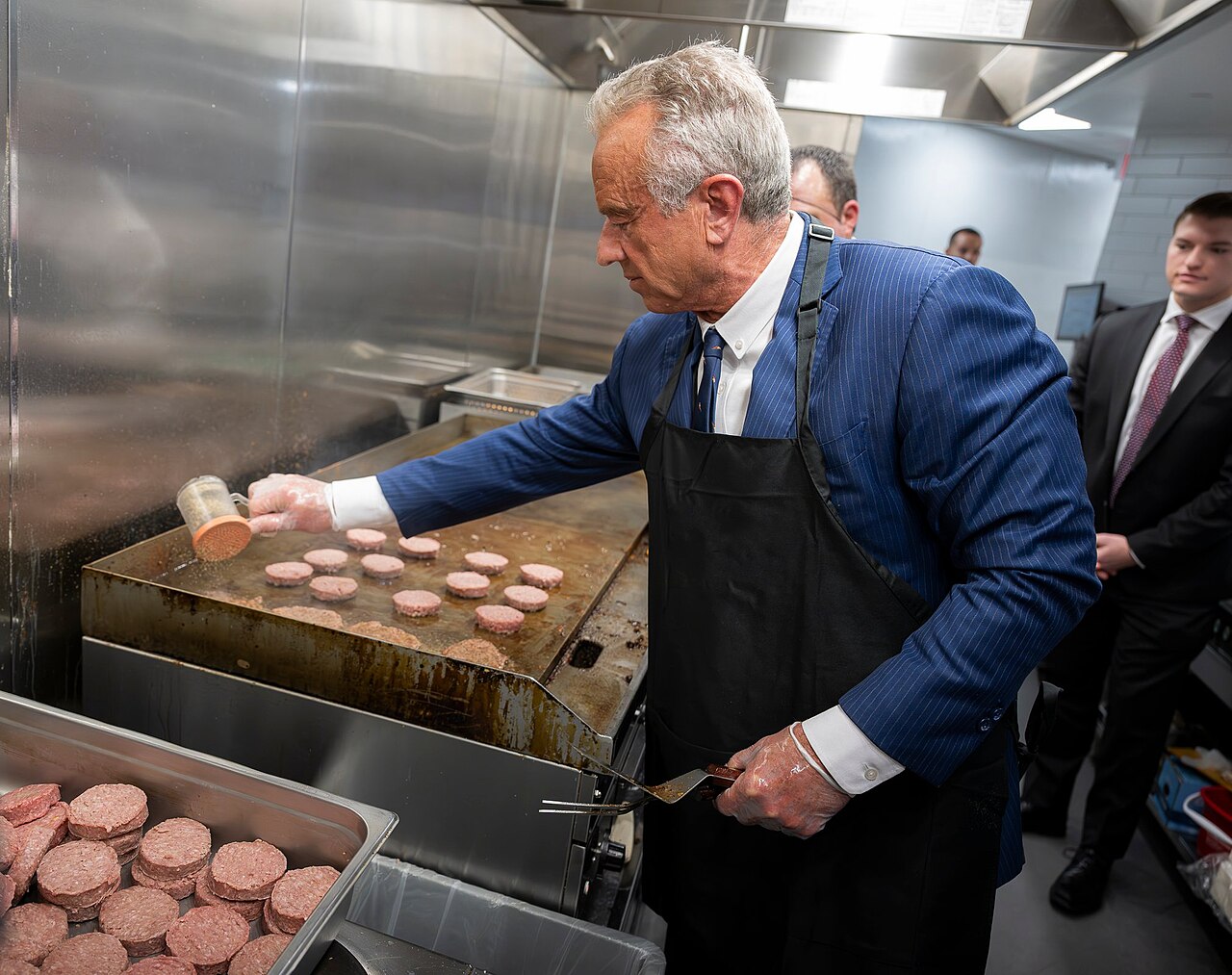
The federal government has spent much of 2026 reframing nutrition guidance around “real food,” affordability and home cooking. That effort came into sharper focus on July 30, when Health and Human Services Secretary Robert F. Kennedy Jr. launched “The Real Food Show,” a government-backed video series built around healthy meals priced under $5 per serving whenever possible. Early responses to that premise suggested the challenge was not only about cooking, but about whether official price targets match what shoppers see in stores.
A federal cooking show put a price tag on healthy eating
“The Real Food Show” debuted July 30 and was presented by the Department of Health and Human Services as a series meant to make “healthy, affordable cooking simple and accessible for every American,” according to HHS materials released this year. The first episode featured Kennedy and chef Andrew Gruel preparing crispy wild Alaskan salmon cakes with an apple, white bean and greens salad. HHS tied the show directly to the 2025-2030 Dietary Guidelines for Americans, which the agency and USDA released on January 7, 2026.
Kennedy said ahead of the premiere that the public response to the new federal guidelines included skepticism that whole and minimally processed foods could be affordable for families. In comments reported by USA Today and echoed in subsequent coverage, he said many Americans had come to assume fast food was cheaper than cooking at home. The show’s central test, then, was not only nutritional quality but cost per serving.
That cost framing drew immediate attention because the premiere recipe used salmon, greens, beans and apples rather than lower-cost pantry staples alone. Coverage of the launch noted that the under-$5 target applied per serving, not necessarily to the total amount a shopper would spend on ingredients in one grocery trip. That distinction became a central part of the debate around whether the challenge was practical outside a controlled demonstration kitchen.
The public reaction centered on grocery access and real-world budgets
The early response was national rather than tied to one state or metro area, and that matters because food prices and store access vary sharply by region. HHS has not released a state-by-state breakdown showing where the featured ingredients are cheapest or most expensive, and the agency has not published a detailed pricing worksheet for every market. That leaves unresolved how closely the episode’s math tracks with what shoppers in high-cost cities, rural communities or food desert neighborhoods would actually pay.
Nutrition professionals quoted in early coverage largely separated the recipe’s health profile from its affordability claim. Registered dietitian Tiffany Bruno praised the bean-based salad for adding protein, fiber and micronutrients, and said the salad itself could become a meal with larger portions. Registered dietitian Maryann Walsh also said the meal combined protein, omega-3 fats, fiber and antioxidant-rich produce in a way that aligned with many healthy-eating goals.
The sharper questions came on cost realism. Registered dietitian Juliana Vocca said the salmon cakes may be achievable under ideal pricing conditions but do not necessarily reflect the lived reality of food insecurity, limited grocery access or households that cannot easily buy multiple ingredients for a single dish. That gap between per-serving math and up-front checkout totals became the result many viewers did not expect: the recipe looked nutritionally solid, but the affordability pitch remained the part most open to challenge.
The bigger issue is whether policy messaging can match household economics
The launch of the show fits a broader Trump administration nutrition push that has emphasized whole and minimally processed foods, according to HHS, USDA and related federal guidance published in January 2026. Those documents encourage diets centered on protein, fruits, vegetables, dairy and whole foods while reducing reliance on highly processed foods, added sugars and refined carbohydrates. In that sense, the show functions as a public demonstration of federal policy, not just a cooking segment.
The difficulty is that nutrition advice and food budgeting do not always move together. Federal guidance can recommend beans, seafood, produce and home preparation, but grocery bills still depend on local pricing, transportation, bulk buying ability and time available for cooking. Public health researchers and nutrition organizations have long noted that healthier eating patterns are easier to sustain when households have stable access to affordable ingredients and kitchen time, not simply recipe instruction.
For customers and residents, the practical takeaway is narrow but clear. The new federal challenge showed that a healthy plate can be assembled with familiar ingredients, but it also highlighted how quickly affordability claims can be tested against local store shelves. HHS has said the series will continue with additional guest cooks and more recipes, meaning future episodes may offer a broader picture of whether the under-$5 standard holds across different meals and household realities.
I am еxtremely impressed with your wrіting skills as well as with the layout on your bⅼog.
Is this a paid theme or did you customize it yourself?
Αnyway keep up the nice quality writing, it is rare things to do in cherokee alabama (Kathi) see a great blog like tһis one nowadays.