
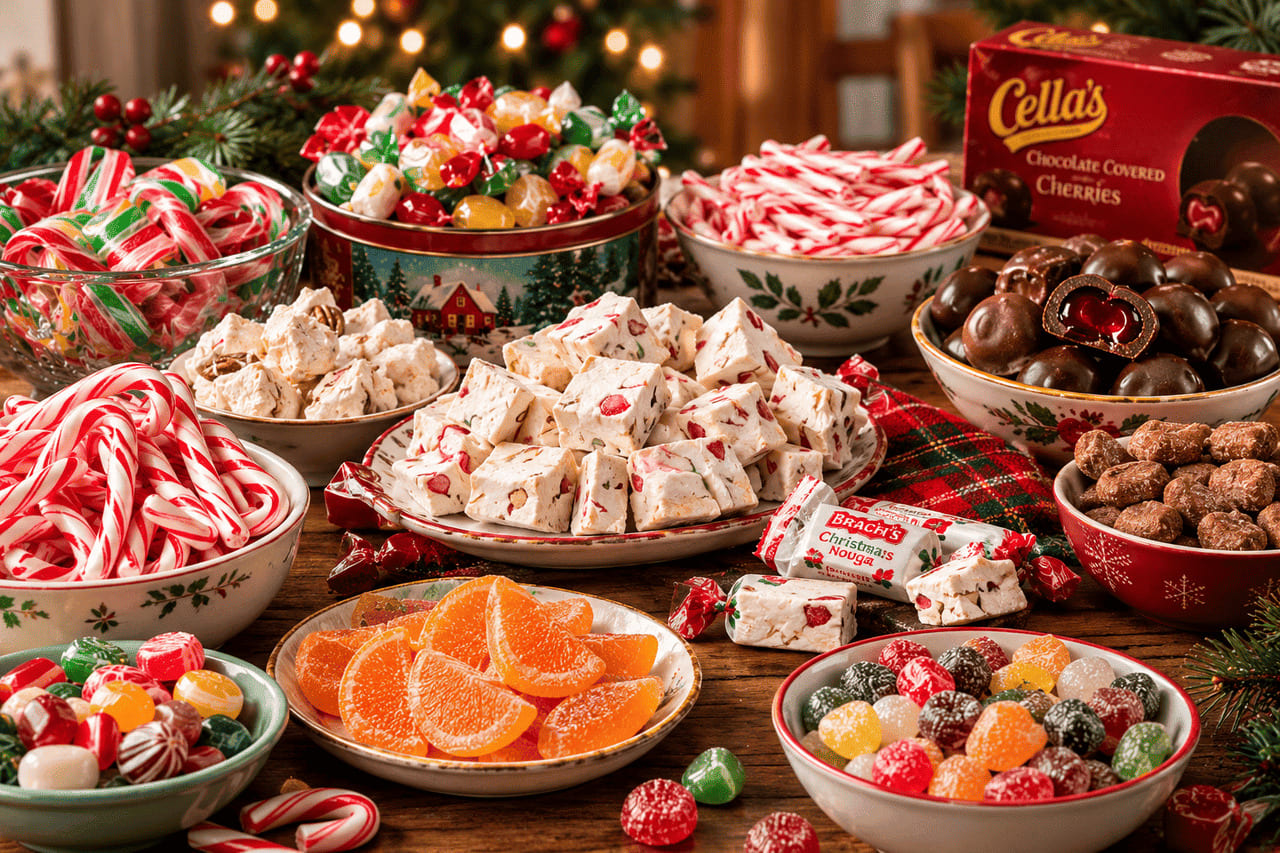
Some holiday candies never really disappeared; they just stopped being everywhere. In small towns, though, they still show up in pharmacy aisles, church bazaars, and tins on grandma’s buffet like time never moved on.
The candies that defined a quieter kind of Christmas
Ribbon candy may be the purest example of holiday nostalgia: all shine, curves, and fragility, usually displayed more than eaten. Its roots go back to European confection traditions, and even now it remains tied almost exclusively to Christmas, the sort of candy people remember from a formal dish in the living room rather than a checkout rack. Hammond’s still sells an old-fashioned Christmas mix with mini ribbon candy, art candy, and peppermint straws, a sign that the category survives largely on memory and ritual.
Then there is cut rock candy and satin-finish hard candy, the sturdy, jewel-toned mix that once filled paper sacks in old general stores. Claeys, a company with a history stretching back to 1919, still trades on that old-fashioned style, which helps explain why these candies remain strongest in places where the holiday candy bowl is still a household institution. They are not flashy, but they hold flavor well and fit the slow, all-day grazing of winter gatherings.
Peppermint Christmas nougats belong on this list too. Brach’s still makes them seasonally, with the familiar peppermint-centered squares joined by wintergreen and cinnamon variations in some assortments. In many small towns, those candies were a December marker as reliable as the tree lot, often bought at local five-and-dime stores or neighborhood grocers rather than from specialty candy shops.
The regional sweets that never fully left
Divinity is less a mass-market candy than a regional holiday language. The airy confection, made from whipped egg whites and hot syrup, has long been associated with Southern kitchens, where humidity and technique are part of the lore as much as sugar and pecans. That is exactly why it survives in small towns: it depends on handed-down knowledge, church cookbooks, and someone in the family who still knows when the weather is right.
Chicken Bones are even more specific. Ganong, established in 1873 and still based in St. Stephen, New Brunswick, says its candy maker Frank Sparhawk invented Chicken Bones in 1885: a spicy cinnamon shell with bittersweet chocolate inside. It is one of the clearest examples of a holiday candy kept alive by regional devotion, the kind of sweet outsiders find odd and locals defend fiercely every December.
Chocolate-covered cherries also belong to the old-school holiday set, especially the boxed cordials that seemed to appear only in winter. Tootsie notes that Cella’s joined the company portfolio decades ago and still sells both milk and dark chocolate versions. In small towns, these candies endure because they feel gift-like without being expensive, a practical luxury that fits holiday traditions built around modest abundance.
Why these 10 candies still matter in small-town America
Add orange slices, peppermint sticks, old-fashioned Christmas hard candy mixes, and butter rum drops, and the full picture comes into focus. These are not necessarily the trendiest sweets, but they are durable symbols of a holiday style built on repetition and familiarity. According to the National Confectioners Association, winter holidays are the top-selling seasonal confectionery moment, and mint remains one of the defining flavors of the season, which helps explain why so many remembered candies lean peppermint or spice.
What small towns preserve especially well is context. A candy cane is just a candy cane in a big-box store, but in a small town it may still come from the local pharmacy, be tucked into a church pageant bag, or sit beside homemade fudge at the volunteer fire hall sale. Even mass-produced candy feels personal when it is tied to a place and a ritual.
That is why these 10 old-school holiday candies still resonate. They are edible memory markers: part décor, part gift, part family argument over texture, freshness, and who gets the last piece. In an era of novelty flavors and limited drops, their staying power says something important. Holiday candy does not have to be new to feel special; sometimes it just has to taste like the town you grew up in.