
Holiday tables do not need another predictable casserole to feel festive. Some of the Midwest’s most memorable dishes are the ones that survived through church cookbooks, family cards, and regional loyalty rather than national fame.
That is exactly what makes them worth reviving now. These foods are rooted in immigration, thrift, celebration, and cold-weather practicality, and many still feel tailor-made for a generous winter spread.
Hearty main dishes with deep regional roots
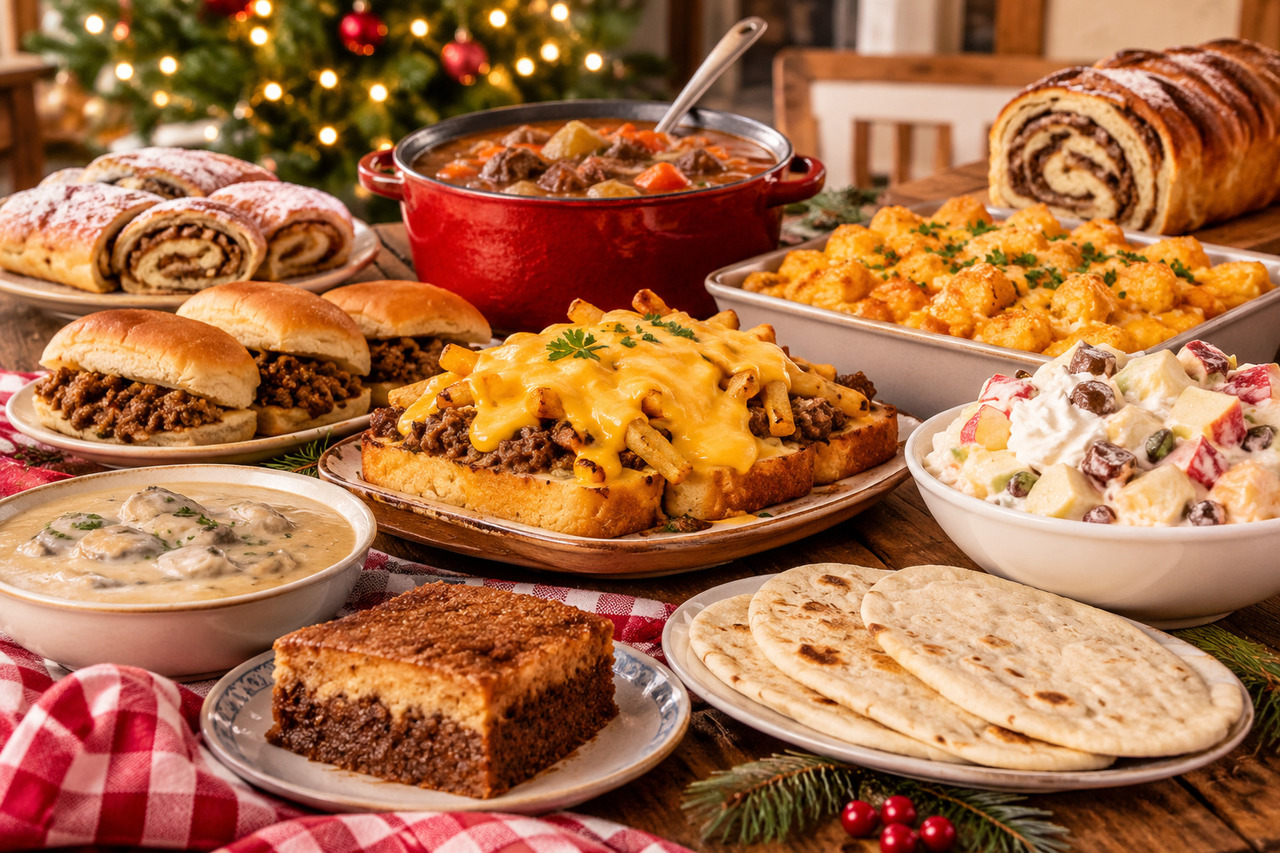
Start with the dishes built to feed a crowd, because the Midwest has long treated hospitality as a serious culinary principle. Booyah, the slow-simmered stew most closely tied to northeastern Wisconsin, remains one of the clearest examples. Smithsonian and Wisconsin reporting have documented its Belgian-American roots and its traditional preparation in large outdoor kettles for church picnics, fairs, and fundraisers, often with multiple meats and vegetables cooked for hours. It is the kind of dramatic, communal centerpiece that instantly changes the mood of a holiday meal.
Nebraska’s runza deserves the same revival energy. Runza’s own history traces the first restaurant to Lincoln in 1949, but the filled bread pocket itself comes from a longer line of Eastern European immigrant baking, with seasoned beef, onions, and cabbage folded into soft dough. On a holiday buffet, sliced runzas bring both nostalgia and practicality. They hold heat well, travel well, and feel substantial without requiring formal carving at the table.
Then there is the Springfield horseshoe, a central Illinois original that Visit Springfield dates to 1928 at the Old Leland Hotel, where chef Joe Schweska created the dish. The classic version layers toast, meat, fries, and cheese sauce into a gloriously excessive open-faced platter. Add Iowa’s loose-meat tradition to the mix, with Maid-Rite tracing its signature sandwich to Muscatine in 1926, and you have a reminder that Midwestern comfort food often favors flavor, texture, and abundance over polish. Even goetta, better known around Cincinnati but familiar across the wider Midwest, speaks to that instinct: Glier’s identifies it as a German-American mixture of pork, beef, steel-cut oats, and onions, designed to stretch meat without sacrificing richness.
Breads, pastries, and side dishes that carry holiday memory
If the main course anchors the meal, breads and sides are where regional memory really shows. Wisconsin kringle is not just a bakery treat; it is a civic emblem. Wisconsin Act 20 made kringle the official state pastry in 2013, formalizing what Racine’s Danish-American bakers had represented for generations. Flaky, oval, and often filled with fruit, nuts, or cheese, kringle offers the kind of sliceable elegance that works equally well at brunch, dessert, or the late-night coffee round.
Lefse belongs in the same conversation, especially in Scandinavian-American communities where it still signals Christmas more clearly than any trendy dinner roll. The soft potato flatbread is often spread with butter and sugar, though savory service works beautifully too. Its endurance says a great deal about how immigrant foodways survive in the Midwest: not always through restaurants, but through seasonal repetition and family expectation.
Potica, sometimes loosely grouped with povitica, adds another layer of holiday history. Official Slovenian sources describe potica as one of Slovenia’s defining festive foods, closely associated with Christmas and other celebrations, and that heritage traveled with immigrants into Midwestern kitchens. Walnut filling remains the benchmark, though poppy seed and other variations appear as well. Alongside these breads, old-school sides like oyster stew deserve attention. Historical accounts from Illinois and Michigan show that oysters once traveled inland to become a Christmas and Thanksgiving luxury, making a milk-based oyster stew feel not odd at all, but deeply traditional.
The sweet, strange, irresistible salads of the Upper Midwest
No survey of nearly forgotten Midwestern holiday food is complete without the dessert-salad tradition, which remains one of the region’s most misunderstood achievements. Snickers salad, documented by Atlas Obscura as an Upper Midwestern potluck favorite, turns chopped apples, candy bars, and whipped topping into something that is somehow both playful and inevitable. It sounds like a joke until it appears next to ham and disappears before the rolls do.
Cookie salad and glorified rice belong to that same lineage. Atlas Obscura has noted both as part of the Midwest’s sweet-salad canon, a category shaped by convenience products, church suppers, and a regional instinct to blur the line between side dish and dessert. Cookie salad, especially associated with Minnesota and neighboring states, leans on pudding, fruit, whipped topping, and crushed cookies. Glorified rice takes cooked rice, pineapple, and cream into equally improbable but crowd-pleasing territory.
Finally, southern Indiana’s persimmon pudding shows how a regional specialty can remain beloved without ever becoming mainstream. Mitchell’s Persimmon Festival, which began in 1947, celebrates the native fruit and the dense, dark pudding made from its pulp. Add in old-fashioned fruitcake’s Midwestern cousins and church-basement bars, and the lesson is clear: the best holiday table is not always the most modern one. Sometimes the dishes nearly lost to time are the very ones that still know how to make guests look up, ask questions, and go back for seconds.