
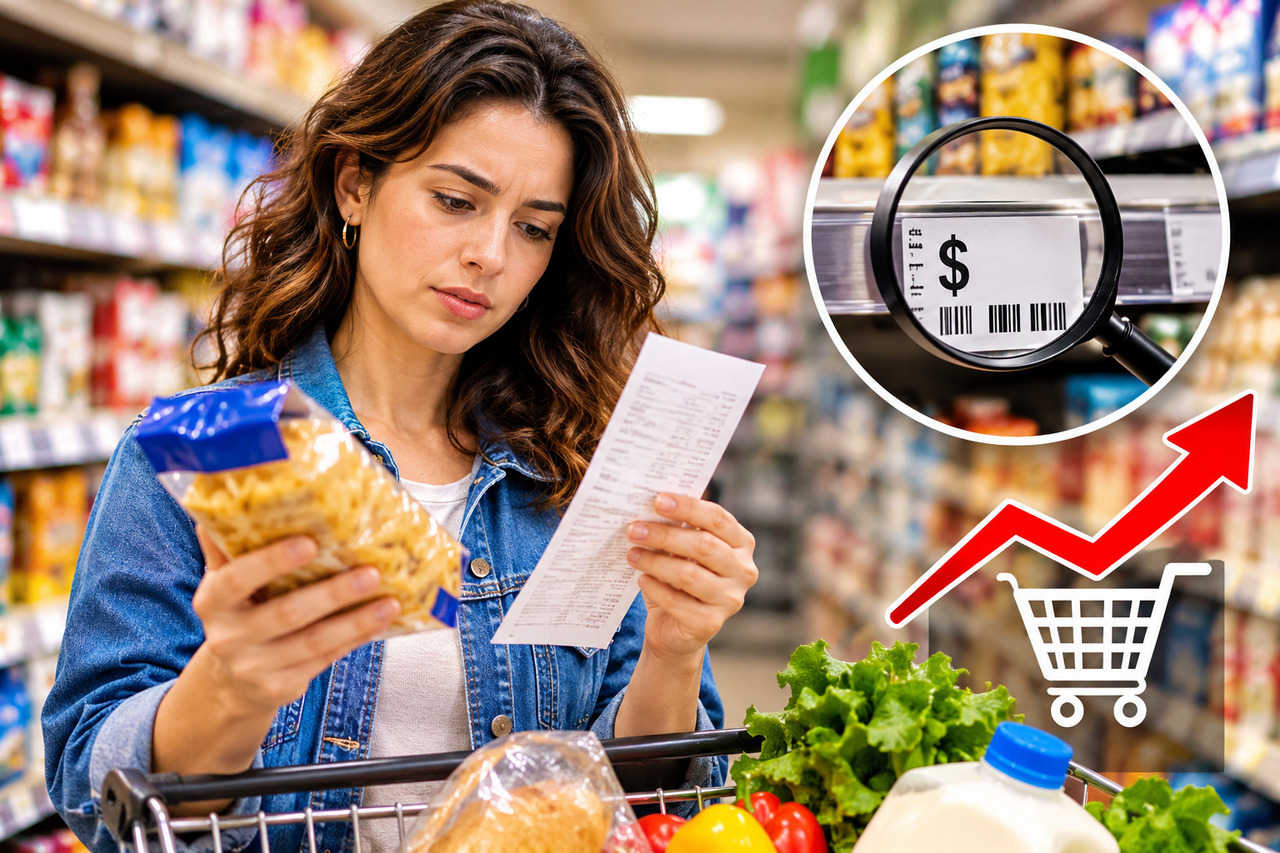
A stack of grocery receipts can show what a cart cost on one trip. Recent survey data suggest the bigger story is how Americans are changing the way they shop, compare, and cut back in response to food costs.
Several new reports point in the same direction: shoppers are not just noticing prices, they are reworking routines in the aisle and at checkout.
What the latest surveys say about grocery stress
Ipsos reported on June 8, 2026, that 58% of Americans said they were paying more attention to the per-unit cost of food items than the total shelf price. The same Ipsos Consumer Tracker found that 52% had changed how often they buy groceries, and 41% said they were buying larger sizes or bulk packages. Ipsos also said 47% were purchasing smaller packages, showing that shoppers are adjusting in more than one direction depending on budget and household needs.
A separate Washington Post and Ipsos poll released July 16, 2026, found that 65% of Americans said groceries were unaffordable for their household budget, while 33% said groceries were affordable. That poll also found a sharp income split. Among Americans with household income under $50,000, 82% said groceries were unaffordable, compared with 70% of those earning $50,000 to $100,000 and 56% of those earning more than $100,000.
Gallup has found a similar sense of strain in broader household finances. In an April 2026 report, Gallup said 31% of Americans named inflation and high prices as the most important financial problem facing their family, and 55% said recent price increases had been a hardship on their ability to maintain their standard of living.
Why the receipt does not tell the whole story
Part of the disconnect is that official inflation data and shopper experience are measuring different things. The Bureau of Labor Statistics said the food-at-home index fell 0.1% in September 2026 and was up 1.8% over 12 months, while food away from home was up 3.5% over the same period. USDA’s Economic Research Service said in its October 23, 2026 Food Price Outlook that food-at-home prices are forecast to rise 2.3% for 2026, with food-away-from-home prices forecast to rise 3.5%.
That does not necessarily mean shoppers feel relief. Numerator said in its August 2026 Economic Sentiment Tracker that 40.5% of consumers identified rising prices as their top concern for the coming year. Numerator also says its Consumer Goods Price Index uses about 7 million verified item-level transactions each month from 200,000 U.S. households, capturing what shoppers actually paid after promotions, coupons, and loyalty discounts.
That matters because grocery stress is often about behavior, not only sticker price. A family can see flat or slower-growing prices in official data and still feel squeezed if it is switching brands, skipping some items, buying fewer extras, or making different sized purchases to stay within budget.
What these findings mean in the grocery aisle
For home cooks, the strongest through line is comparison shopping. Ipsos found the shift toward unit-price checking was especially pronounced among lower-income consumers, at 70%, and among adults ages 35 to 54, at 69%. That suggests many shoppers are looking past the headline shelf tag and doing more math on package size, pantry life, and how many meals an item can stretch.
The shopping trip itself is changing, too. Gallup reported in October 2026 that 15% of Americans now order groceries online at least weekly, up from 4% in 2019, while weekly in-person grocery shopping fell to 74%, a trend low in Gallup’s tracking. Gallup said higher prices, including a spike in gas prices, may have led some consumers to make fewer trips.
Taken together, the surveys suggest grocery anxiety is showing up as a series of trade-offs. People are scanning unit labels more carefully, changing trip frequency, shifting package sizes, and trying to make each purchase work harder. The receipt still matters, but the habits around it may say even more.