
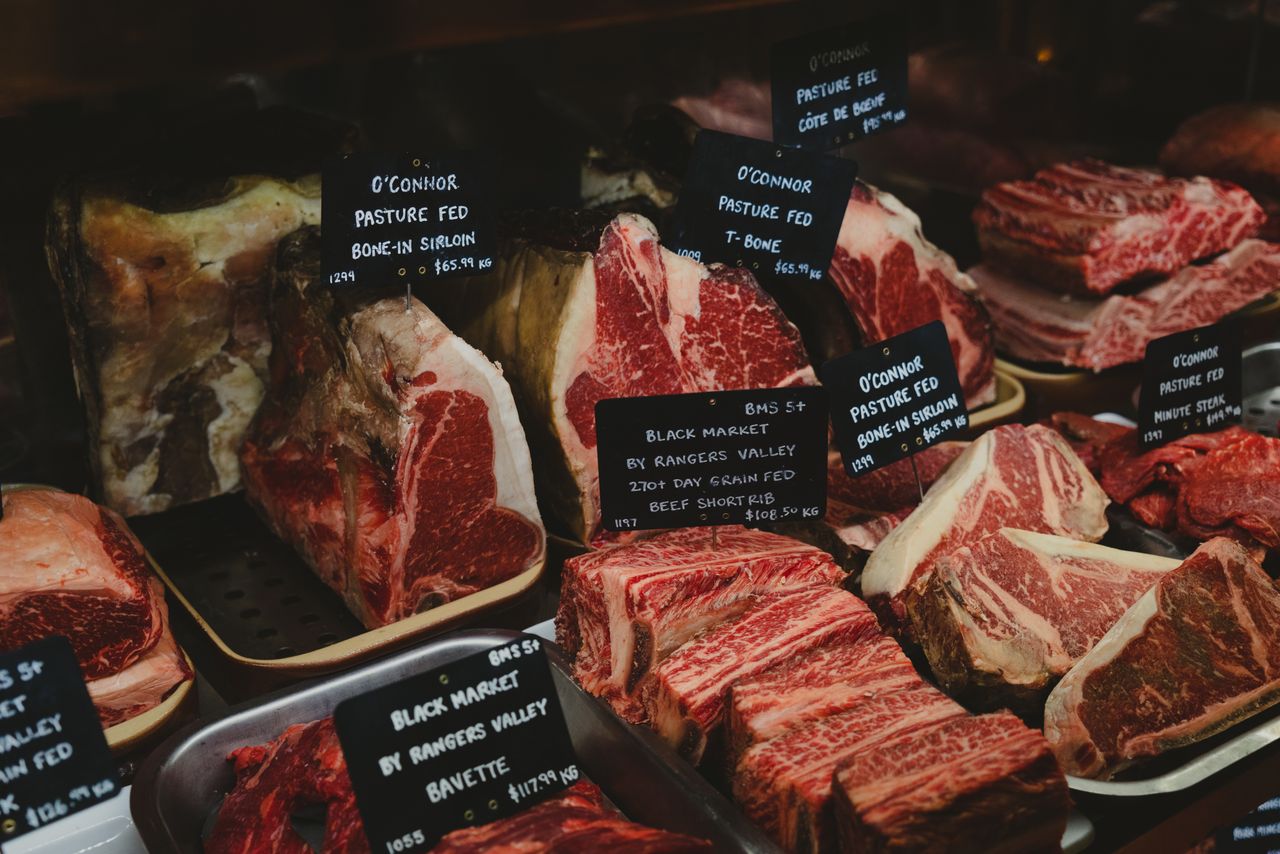
Beef is commanding more of the American food dollar in 2026, even as overall food inflation remains broad across grocery stores and restaurants. The shift is showing up most clearly in beef, where rising prices are driving spending higher while the number of packages and menu items consumers buy is moving the other way. Industry data published August 26 show that Americans are paying record-level prices for beef products, but purchasing less of them by volume.
Beef spending is rising because prices, not demand, are doing the work
Numerator data reported August 26 by Nation’s Restaurant News show beef prices have risen 25% since 2023, far outpacing poultry and pork. According to that report, beef now accounts for 56% of sales generated by the three biggest animal proteins — beef, pork and poultry — up one percentage point from a year earlier and the highest share since 2019. Numerator said a single percentage point in that mix is worth roughly $1 billion in sales, underscoring how much pricing has shifted the category.
That sales growth is not being driven by consumers buying more beef. The same Numerator data show beef unit share, a measure of the amount actually purchased, fell by 0.8 percentage points over the same period. In practical terms, Americans are spending more money on beef while taking home fewer units.
Restaurants are seeing the same math. Numerator found prices for burgers and other beef sandwiches at fast-food chains have increased 28% since 2023 to an average of $6.70 per item. Chicken prices rose 12% over that stretch to $6.80, leaving beef with much less of the price advantage it once held on value menus and combo boards.
The effect is national, but shoppers are feeling it differently at the meat case and drive-thru
Because this is a national pricing trend rather than a single-company action, there is no state-by-state closure list or recall-style distribution map attached to the story. What is confirmed is that higher beef prices are affecting both supermarket purchases and restaurant menu economics across the United States, according to Numerator and USDA market outlook data. What is not yet publicly broken out in the reporting is a full state-level comparison of where consumers are cutting back most sharply.
For shoppers, the clearest local impact is likely showing up at the checkout lane and in menu choices. USDA’s Economic Research Service said this month that food-away-from-home prices in 2026 are forecast to rise 3.6%, while tight cattle supplies are expected to reduce year-over-year beef production in the second half of the year. That means the pressure on beef-heavy restaurant concepts has not fully eased.
USDA also has projected lower domestic beef availability per person. An ERS chart published in 2025 forecast per capita beef availability at 56.9 pounds in 2026, down from 58.5 pounds in 2025. Availability is not identical to consumer purchases, but USDA uses it as a proxy for how much product is moving through the market.
Tight cattle supplies remain the central reason prices are staying high
The main cause is supply. USDA’s National Agricultural Statistics Service said on July 24 that the United States had 28.5 million beef cows as of July 1, 2026, down 1% from a year earlier, with the total cattle and calf inventory at 94.2 million head. USDA has separately described the cattle herd as sitting at its lowest level in roughly 75 years, a contraction that has limited beef production and supported high wholesale prices.
USDA and ERS reports tie that cycle to several overlapping pressures: drought and poor pasture conditions, high hay and feed costs in earlier years, the long biological timeline required to rebuild herds, and broader input-cost pressures on producers. ERS noted that low supplies in 2026 were expected to push cattle prices to record territory before easing later in the decade as production cycles recover.
For consumers, that means higher beef prices do not necessarily signal stronger appetite for beef. They more often reflect a smaller herd, reduced supply and menu pricing that restaurants use to protect margins. USDA’s latest market outlook said cattle prices may remain supported into 2027 because supplies are still tight, even as the agency expects some production conditions to improve over time.
Top quality gaming experience and the customer support is very helpful. Give evojililogin a try
Really impressed with the bonus offers here. It gave me a great head start when I first signed up. The slots are fair and the graphics are top notch. Give abjilicasino a try if you love big wins!
Best spot for sports and slots combined. I love that I don’t have to switch accounts to bet on my favorite team. idbolaslot88 is definitely a top-tier choice.
I’ve been playing here for a few weeks now and the payout speed is actually impressive. Definitely one of my favorite spots to unwind. Check out phwin7 for a great experience!