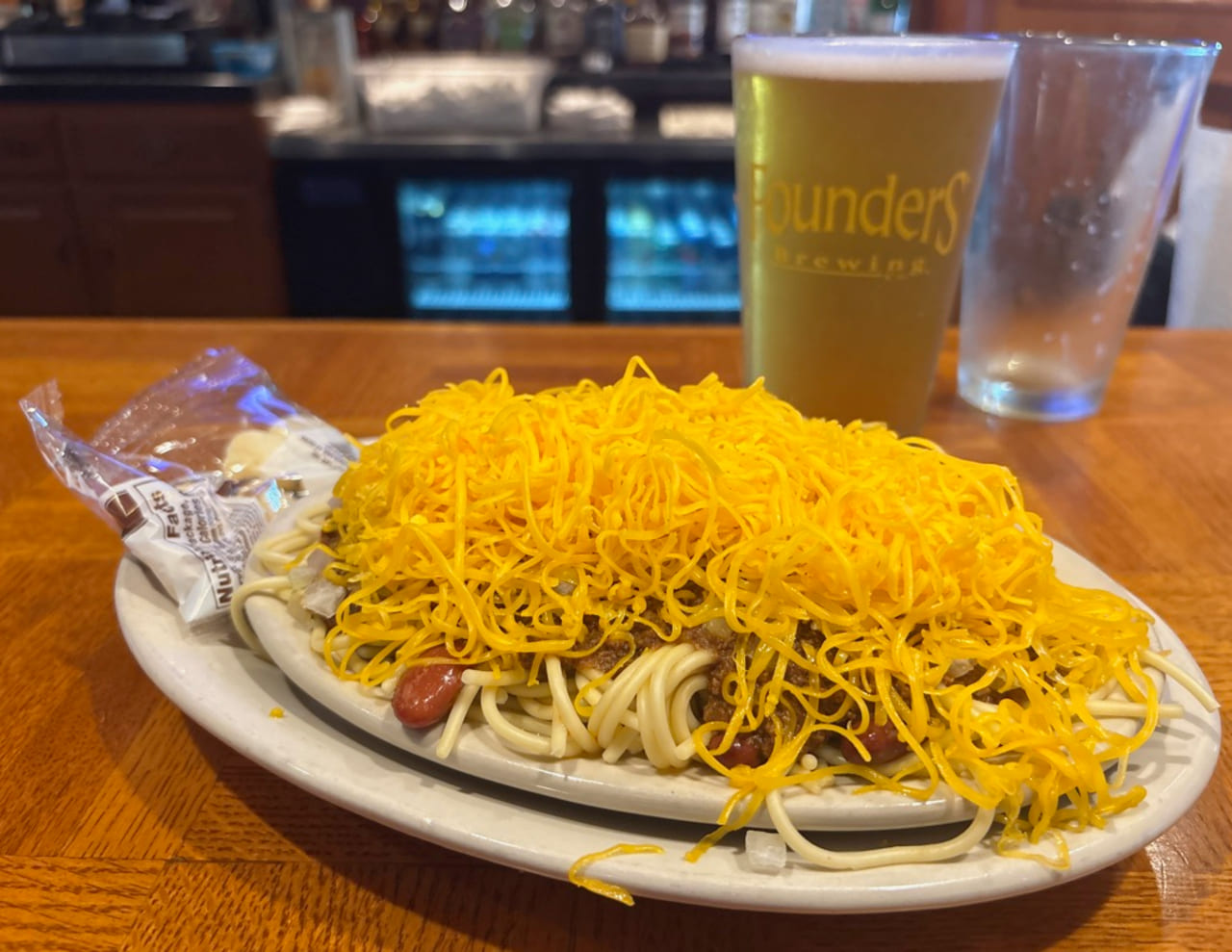
It looks wrong to some people at first glance. To others, it looks exactly like home. Few regional dishes in America provoke stronger opinions than Cincinnati chili draped over spaghetti and buried under a bright orange hill of shredded cheddar.
Why Cincinnati chili inspires such strong reactions
The argument begins with expectation. Many diners hear the word “chili” and picture a thick Southwestern or Texas-style bowl built around beef, chiles, and sometimes beans. Cincinnati chili is something else entirely: a finely textured meat sauce seasoned with warm spices, served over spaghetti as a “3-Way,” or expanded with onions or beans into a 4-Way and 5-Way. Skyline Chili describes the 3-Way as spaghetti topped with its signature chili and a mound of shredded cheddar, while Gold Star similarly emphasizes that Cincinnati chili should not be confused with “regular” chili.
That difference is exactly what turns first bites into hard opinions. For skeptics, the combination can feel like a category error, especially because cinnamon and other warm spices are part of the flavor profile. The Associated Press has noted that Cincinnati chili commonly includes cocoa, cinnamon, and allspice, ingredients that make it read less like standard game-day chili and more like a spiced meat sauce to outsiders.
But the same traits that repel some diners are what loyalists crave. The texture is engineered for layering, not ladling, and the dish is meant to be cut with a fork rather than twirled like Italian pasta, according to Skyline’s own explanation of how to eat it. What critics call strange, fans call precise, balanced, and unmistakably regional.
The immigrant story behind the spaghetti-and-chili tradition
Cincinnati chili did not emerge as a gimmick. It grew out of immigrant cooking traditions adapted to American restaurant culture in the early 20th century. Smithsonian Magazine traces one branch of the story to Macedonian immigrants Tom and John Kiradjieff, who created a spiced chili sauce in 1922 for hot dogs, while Skyline says founder Nicholas Lambrinides brought family flavors from Greece and opened Skyline Chili in Cincinnati in 1949.
That background matters because it explains why the dish resists neat classification. Cincinnati chili belongs to a broader American pattern in which immigrant cooks fused Mediterranean spice traditions with fast, affordable diner food. Gold Star explicitly describes its version as a blend shaped by Mediterranean herbs and spices, reinforcing that this style was never intended to mimic a bowl of frontier chili.
Served over spaghetti, the dish also made economic and operational sense. Pasta stretched portions, moved quickly in restaurant settings, and turned chili into a full meal rather than a topping alone. Over time, that practical format became ritualized, with locals ordering by number and “Way” as naturally as coffee or pie.
Why neither side is backing down now
The debate endures because Cincinnati chili is no longer just a dish; it is an identity marker. Skyline continues to expand grocery and restaurant offerings and says it is focused on franchise growth in the Midwest and Southeastern United States, while Gold Star promoted Cincinnati Chili Week in 2026 with discounted 3-Ways and Cheese Coneys. That kind of institutional support keeps the dish highly visible and gives locals fresh reasons to defend it.
The food also benefits from a built-in initiation ritual. Visitors try it because they have heard the jokes, seen the social media arguments, or been challenged by friends. Then they pick a side. AP recently described Cincinnati as having a distinct hot dog and chili culture, with finely textured chili, mustard, onions, and a mountain of shredded cheese defining the local style.
That is why the argument stays lively but rarely damaging. Critics still see spaghetti under chili as a culinary offense, while believers see a historic regional specialty that outsiders simply misunderstand. In a national food culture obsessed with authenticity, Cincinnati chili keeps proving that authenticity does not always look familiar, and that may be exactly why nobody is backing down.